How to Find B2B Customers: A Practical Guide for Small Businesses
Find businesses that need you now, and reach them the right way.
Selling to other businesses is different from selling to the public. A business buys when it has a reason: it has just opened, it is growing, it is hiring, or something it uses has stopped working. If you can find businesses at that moment and reach the right person with a short, useful message, you will win more customers with less effort.
This guide shows you how to find B2B customers step by step, whether you do it by hand or let Machinence Find Customers do the searching for you.
What makes B2B customers different
- They buy for a reason. A business rarely buys on impulse. Something has changed that makes your product useful now.
- A person decides. Behind every business is an owner, a manager or a director. Your message has to make sense to them.
- Timing matters. The same business can ignore you in March and welcome you in June, once it has opened a second site or lost a supplier.
Step 1. Describe the businesses you sell to
Write one sentence about your ideal customer: the type of business, its size and where it is. "Independent hair salons and barbers in Leeds" is far more useful than "small businesses". Then add the sign that tells you they need you, for example "has no website of its own" or "opened in the last year".
Tip: start with one type of business in one area. You can widen the search once you know what works.
Step 2. Find businesses that match
You can do this by hand. Search maps and directories for your type of business, check trade associations and local business groups, and in the UK look up new companies on the public Companies House register. It works, but it takes time: every business has to be checked one by one to see that it is real, still trading and not a competitor.
Keep everything you find in one list, with where you found it, so you never contact the same business twice.
Step 3. Find a reason to contact them now
A good B2B lead comes with a reason. Look for public signs such as:
- a newly registered company or a new location,
- a job advert for the kind of work you do,
- a new website, or no website of its own,
- reviews that mention a problem you solve,
- news of funding or expansion.
Mention that reason in your first line. It shows you have done your homework, and it answers the question every owner asks: why are you writing to me?
Step 4. Contact them the right way
Use a public business contact route: the email address, phone number or contact form the business shows on its own website. Keep your first message to two or three sentences: who you are, why you are writing now, and one simple question.
Follow up, but not forever. One or two polite follow-ups are normal; stop as soon as someone replies or asks you to stop. In the UK, a sole trader's business details can still count as personal data, so check the email rules before you write to a sole trader or a partnership.
Step 5. Track every lead
Put every business you contact into a CRM, with the date, what you sent and what they said. When a lead replies, you will know exactly where you left off, and nothing falls through the cracks. The Machinence CRM is included in every plan.
How Find Customers does steps 2 to 5 for you
Find Customers is built for small businesses without a sales team. You tell it what you sell, who your ideal customers are and which countries to search (up to 5), and it searches the web for businesses that could buy from you.
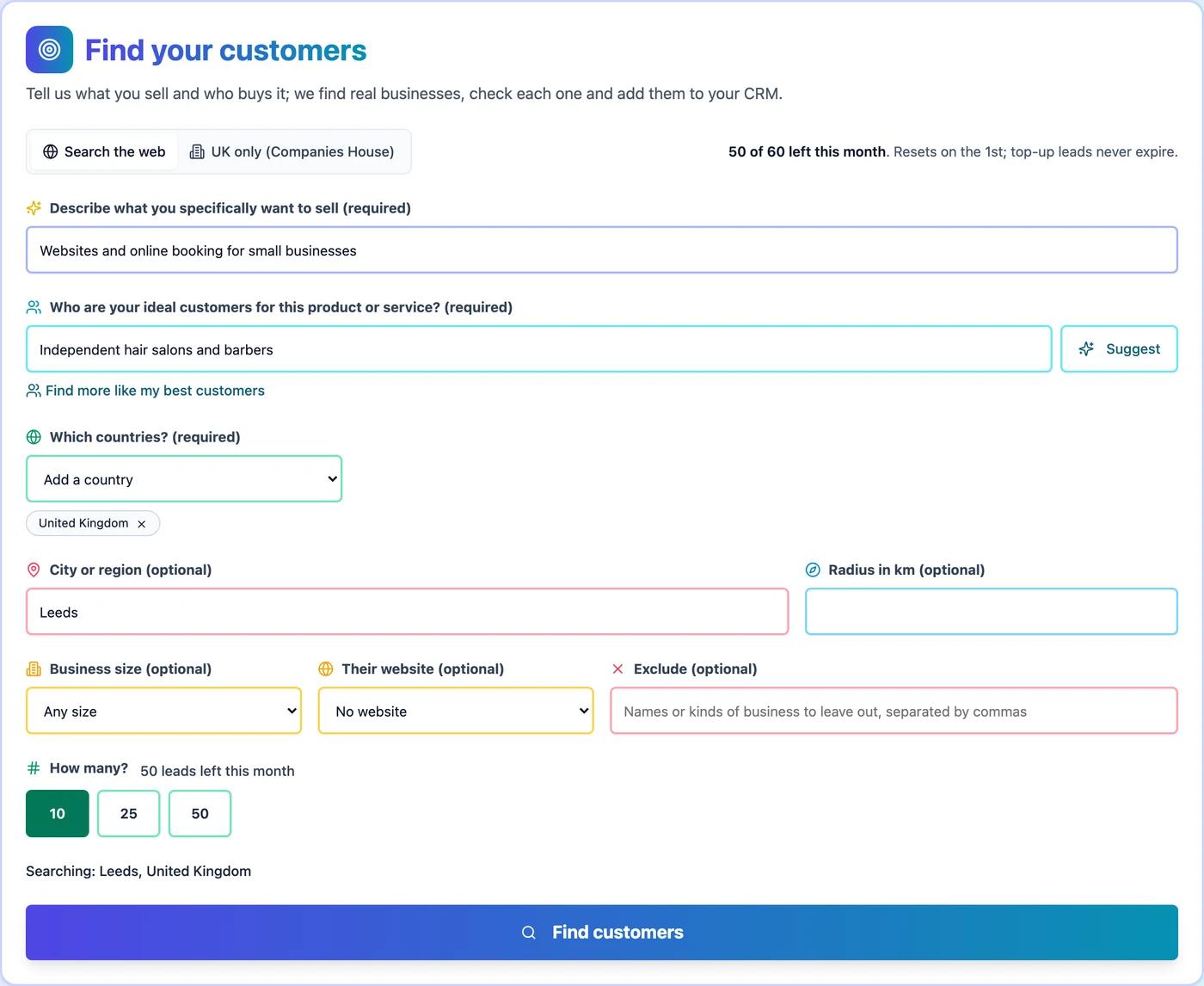
- Checked results. Every result is checked first, so competitors, suppliers, agencies and directories are left out, and each lead has a quality score out of 100.
- Hot, Good or Possible. Each lead is labelled, so you know where to start, with its name, website, location and where it was found.
- Why now. Leads can show a fresh public reason to contact them from the last 6 months, with its date and source link. A reason from the last 90 days marks the lead Ready now.
- Public contact routes only. It never guesses email addresses. In the UK, companies show their current directors from Companies House (names only).
- Every way in. For each lead you get a short first email, follow-ups on day 3 and day 7 that stop when the business replies, a call script, a LinkedIn note, a WhatsApp message (only when the business lists a mobile number) and a letter.
- Into your CRM in one click.
Find Customers finds business customers, not individual consumers. If you sell to the public, you can still use it to find partners and referrers nearby.
Try it free
On machinence.io you can run one free Find customers search with just your email: it shows 3 sample leads in full. The 7-day free trial includes 10 qualified leads and never asks for a card. Without a card, email and phone show for the first 5 leads; adding a card unlocks the rest, and nothing is charged until the trial ends.
Want a walkthrough of the tool itself? Read How to find customers using AI. Selling abroad? See How to find international business customers.
Frequently asked questions
What is the fastest way to find B2B customers?
Pick one type of business in one area, look for a public reason to contact them now, and send a short message through their own business contact route. A tool like Machinence Find Customers does the searching and checking for you.
Where can I find business leads for free?
Maps, directories, trade associations and, in the UK, the public Companies House register. On machinence.io you can also run one free Find customers search that shows 3 sample leads in full.
Does Find Customers find consumers?
No. Find Customers finds business customers (B2B). A business that sells to the public can use it to find partners and referrers nearby.